Showing posts with label Grade 6. Show all posts

Thursday, October 04, 2012

Exploring light and dark


Sunburst and I spent some time over the summer exploring the lovely qualities of charcoal.

We decided to tackle a series of exercises from Thomas Wildgruber's inspiring book, Painting and Drawing in Waldorf Schools, and we had so much fun.  They start very simply with spheres, and then increase in complexity with each exercise.


The guidance provided with these drawings is wonderful.  I was required to do a little bit of charcoal work in college, but with very little guidance.  Looking back at my youth, I am so aghast that I paid and attended college level art classes that involved no actual instruction.  While we inadvertently learn something through our own repeated ill-attempts, with guidance the process is much less painful and infinitely more productive.

Another thing that struck me about these exercises is that even with such a simple medium, the results vary.  While Sunburst and I were drawing the same things, stylistically, there is a huge difference.  Her drawing style with charcoal has a scratchiness to it that no matter how hard I try, I cannot manage to replicate.  The same is true for her-- she can't soften her drawings to match the feel of mine.  We had a lot of fun trying though.  And as Sunburst is getting older, she really enjoys it when there is something obviously off about my drawings.  Yes, the teenage years have truly begun!

Here you can see the style differences.  I wonder if it has anything to do with temperament.


At one point in the exercises you progress to drawing your own image using what you've learned-- the examples for this exercise differ between the German and English editions.   Sunburst couldn't wait for this exercise, because of course she knew exactly what she wanted to draw-- horses!


I was more reluctant because I had absolutely no idea what to draw. In the end though I managed to surprise myself.


We took a small break from there to begin our study of discovery, renaissance and reformation.  We hope to get back to it and complete the last three exercises-- trees and landscapes.  The difference these charcoal drawings have made in Sunburst's renaissance artwork is definitely noticeable.  On more than one occasion lately I have heard her exclaim, "Did I really draw this?!"

We've moved on into taking the dark/light exploration into our work with colored pencils, and the results are really fun.  Moonshine, meanwhile, has been watching this progression with awe.  "Will I be able to draw like that too someday?"

"No," Sunburst told her with all sincerity.  "Your drawings will be even better."


Monday, October 01, 2012

Book review: Painting and Drawing in Waldorf Schools


Painting and Drawing in Waldorf Schools: Classes 1-8 by Thomas Wildgruber

This is a book I've been wanting to write a review on for a couple of years.  I first stumbled upon it at the Goetheanum bookstore in Switzerland with my good friend Cari.  One look inside the book and we were both immediately smitten.  It didn't matter that the text was in German or that its purchase price was enough to choke a horse-- we both HAD to have it.

Early this summer it was released in English, and I hemmed and hawed about whether or not I needed a copy of it that I didn't have to translate.  The pre-order price at The Book Depository made it worthwhile though-- a mere pittance compared to what my German copy cost me.  So I winced only slightly before clicking the order button, and I'm so happy that I did, because while most of it is exactly the same, some things and images are different.  Plus, it saves me the time and effort of translating.

Let me repeat myself.  This book is so good that I bought it TWICE.

It's a wonderful guide to every type of painting and drawing experienced within Waldorf education.  Almost every section contains step-by-step guides and thoughtful commentary.  The pictures alone are so inspiring.  This is the book I had wished for when I started homeschooling Sunburst so many years ago and had only the vaguest idea what main lesson artwork should look like.

This is the book we've been waiting for.

Included in this masterpiece are the beginning painting lessons-- the ones that leave most of us homeschoolers with our heads spinning.  It goes on to give a wealth of painting examples for the main lessons in grades 2-5.  As a busy homeschooler teaching three grades, there are not enough hours in the day to do this many paintings.  But I love that they exist.  I love being able to flip though the book and pick and choose a few ideas to bring here and there.  Some ideas I change because that's the nature of art, and others I bring as is because they are just that good.

One major thing this book has done for us is to re-enliven our form drawing.  Form drawing is actually presented very differently in Europe than in the United States.  Okay, I don't know if I can honestly say "all of Europe," but I can definitively say that the main lesson books I saw when I toured the Steiner schools in Switzerland were filled with very colorful form drawings, not much different from the ones in Wildgruber's book.

Here's an example from our own form drawing lessons so you can see what I mean.


It's the same drawing, and yet it looks so much more impressive, inviting, and exciting.  Shaded with rich contrasting colors it becomes this palpable thing.  For those of us who were introduced to form drawing as practiced in the states, this is like a free pass.  There is no need to wait for freehand geometry in fifth grade to make form drawing look this beautiful.  And it helps my children to fill in the enclosed spaces so they can really grasp the feeling-- did they create balance?

Other sections of this book that I particularly love for the lower grades are the botany paintings and the drawing section with inspired artwork to display in the classroom.  If only I could draw this well!  The author goes so far as to recommend that children will learn more from our guided drawing examples on paper than from our use of blackboards.  I have noticed this to be true with my own children, and it is so nice to hear someone say this.

For the middle grades, I love that there are several wonderful explorations of light and shadow using different mediums.  And as if the book wasn't already useful enough, the entire section on perspective drawing is priceless.

But you shouldn't take my word for it.  To see all that's on offer here, you should have a look at the Table of Contents which is available as a pdf download HERE.  And then take a look at some of the images included in the book gallery HERE.  (Note, some of these images have been replaced by even better ones in the English translation.)

I absolutely adore this book.  I could go on and on.  There is one series of exercises that Sunburst and I attempted over the summer that really lifted our work in so many ways.  I look forward to sharing some of our drawings with you in the next few days, so I hope you'll come back for that.

Now if only we had a book like this for the high school grades...  Yes, I can dream!

Wednesday, September 15, 2010

Wir schreiben Deutsch!


Yesterday I told you about the German lessons I created for my children.  Today I want to tell you about two books we're using for book work and how we're making them fun.

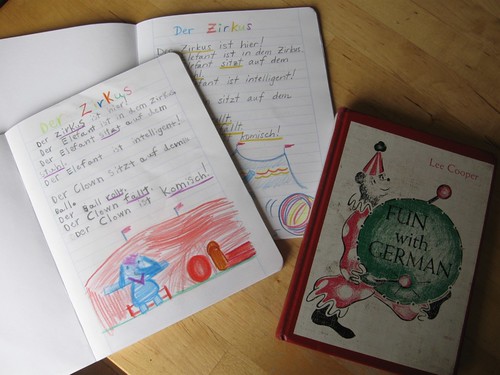
Moonshine, my 8.5 year old, is using "Fun with German" by Lee Cooper.  It's written for English speakers, and the point is to be able to pick it up and read in German from the very first page.  It's empowering, it's colorful, and it's fun.  It actually is.  It touches on pronunciation, starting with very small steps, and continuing on in such a simple manner that before long you are actually reading and understanding quite a bit of German.

Moonshine is LOVING it.  She can't get enough of it lately.  It's what I find her doing first thing in the morning and the last thing in the afternoon.  We're both hoping it will help her feel even more empowered.  She is already tickled by the fact that she can now read in German.

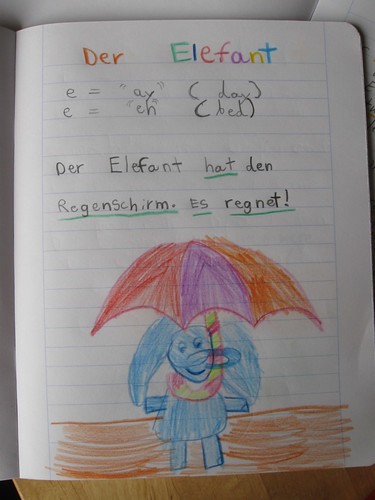
We're taking each page and turning it into a lesson-- reading it aloud many times, copying the writing and the picture, underlining whatever words she wants to underline-- those new to her or ones she thinks are new to her-- and sometimes adding in a new word that she might need help pronouncing.  We're using colored pencils to make it more fun.  And I'm doing it along with her in my own book.  My kids really enjoy embarking on a project together with mom, it feels special and important.  And she's so proud of herself already!

Here's what her first few lessons look like:


And then she noticed there were so many words that mean "the" -- so I explained and we made a page for them.  In Moonshine's drawing below, the gender neutral quality of das is illustrated by a "suitcase" she says.


The thing about this book is that you don't have to work hard to make it exciting.  The pages in the actual book look pretty much the same:


And 30-odd pages later you're able to read something of this length:

 
Doesn't it look like a fun book?  I can't say enough good things about Lee Cooper's books.  They are all like this-- Fun With Spanish (two books), Fun With Italian, Fun With French... They're old enough to be out of print, but there are still many cheap copies to be found in a quick Google search.


Sunburst, my 11.5 year old, is using the Das Sind Wir readers by Peter Oram.  He created these German readers for use in Waldorf schools in the UK, and they are very well done.  Each book (there are two) has fifteen lessons.  They're meant for Grades 5-6, I think, and they assume that the child has some grasp of the language already... which is perfect for Sunburst.


Each lesson has a theme (waking up, school, my city) and at the end of each lesson are the related vocabulary words and phrases for that lesson.  In the back of the book there are some questions pertaining to each lesson, meant for the teacher's use, as well as a lesson by lesson glossary.

My only problem with this book is that it assumes the teacher is fluent in German.  All the material directed at the instructor is also in German... and while I get the gist of some of it, I haven't had the time or the inclination to really sit down and fully grasp how I'm supposed to be using it.  So I'm making it up.

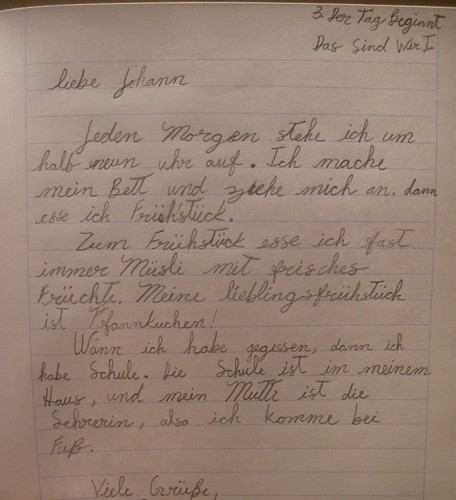
First we read the lesson together.  She likes to read it in German and then translate it aloud to the English equivalent.  Then we take this lesson and pretend it's a letter which we have to reply to-- at the end of each lesson, as part of the reading, are questions based on the reading (Where do you live?  What do you play?  Are you fully awake?) And so we use those as a jumping off point and write a letter to the boy in the lesson.  If he talks about his town, then we do, too.  And we make sure to answer his questions.  We keep our letters in simple little notebooks.

Just to give you an idea, here are a couple of Sunburst's (uncorrected)"letters."


This is really fun for Sunburst, and again, she loves that I'm doing it with her. We compare what we wrote, and it's really interesting to see how different our letters become. We're doing one lesson per week, and that seems like plenty. Her goal is to be able to check out books at the library and read to her heart's content. I think by the time she's finished with these books she'll have no problem. Certainly she will be able to check out German early readers after only a few more lessons.

You can find all of Peter Oram's books at the website Starborn Books.

(This is my first post with the new Blogger interface, and it's giving me fits.  So if it looks too wonky on your end, please let me know.  Thanks!)

Monday, September 13, 2010

Wir sprechen Deutsch!


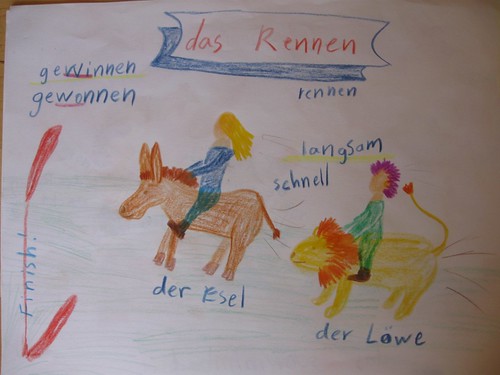
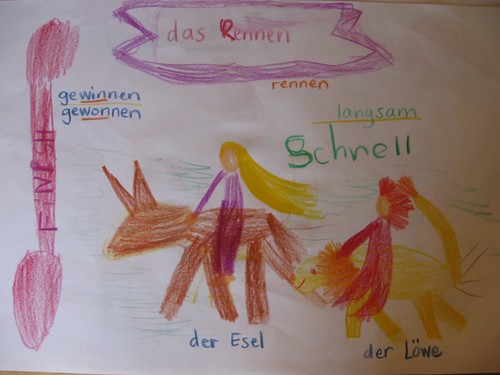
Today I found myself acting out a wild story about a boy who wanted to make a birthday cake for his friend, with candles, but he didn't know how old she was. He called her on the phone, but it was a bad connection. So he mailed her a letter, but he forgot to use a stamp. Then he decided to go ring her doorbell, but the doorbell was broken. So he knocked... nothing. Then he began pounding and banging on the door, but no one heard because the mother was running the vacuum cleaner.

Imagine, I'm standing there banging furiously on the dining room door with one hand while with the other I am running the vacuum cleaner and pretending not to hear. Meanwhile my kids are calling out suggestions, laughing and smiling, and completely engaged. They love it so much, and I'm so pleased-- because we're actually, at this moment, homeschooling. And what I'm presenting is their German lesson.

The funny thing is, I don't speak German. Not really. I took it in college, but outside of class, I didn't use it. Not once. And if you don't use it... well, in twenty years time it just seems to float away on the breeze. It's not the most useful language you can learn as an American living in the Southwestern US. Spanish would have been a more obvious choice, and I probably would have stayed that course had my friend and I not met these cute Austrian brothers at the opera. The college crush, both blind and fleeting-- it was as good a reason as any to learn a language. Even if I never used it again... and I didn't. Not until I decided to teach it to my kids, and then I had to start over, from scratch.

When we lived in the US and my girls were younger, I used songs and games and very basic attempts at language introduction. For resources I googled fingerplays and checked out picture books and cds from the library. I sang them songs and made up silly little games. My goal was not to create fluent speakers. I simply wanted them to play with the idea of language-- hear new sounds and try to make them. If they learned a few words and had fun doing it, then that was a bonus.

And then we moved to Switzerland, and my focus changed. For the first year we honestly didn't even need German. Hardly anyone spoke to us in the city, and so our language usage was pretty much confined to asking for a bathroom and reading ingredient labels on food packaging. Now that we've been living "auf dem Land" for the last year, learning the language has become somewhat of a necessity.

It's hard teaching a language when you don't speak it fluently yourself. We've tried just about everything-- Rosetta Stone, books, cds, random internet resources... The materials I've found just aren't enlivened enough. So I decided to make my own. I've started putting together a few ideas from here and there, including psychology research on language acquisition, and the girls can't get enough of these lessons. They love them. They beg for them. And it makes me so happy.

And just in the last few weeks that I have been implementing this, I have seen a HUGE change in the girls' language abilities. And in my own. I'm far from fluent-- but I think we're definitely onto something VERY good here. Even the neighbors have been commenting to me about how well the girls are speaking lately, and I couldn't be more encouraged by this. It's astounding, really. Every day they come in from playing to tell me excitedly that they understood something someone said, or said something that was understood. They are starting to feel empowered again. Imagine that! It makes me cry, really.

Basically, I'm telling very short, simple, thematic stories twice a week. I have two characters, Johann and Julia, and the stories revolve around their comical interactions with each other.

My rules for the stories are:
  1. I have to tell the whole story in German (as best as I can).
  2. It has to build on words they already know.
  3. The words have to be contextually connected and useful.
  4. It has to be simple.
  5. It has to be funny.
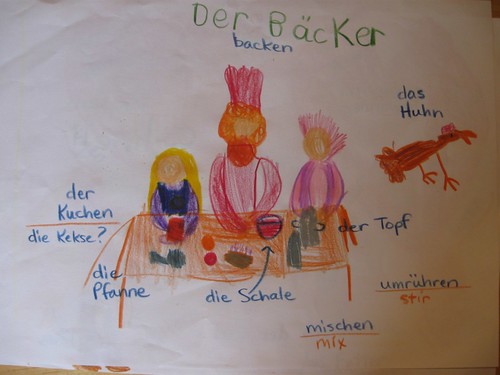
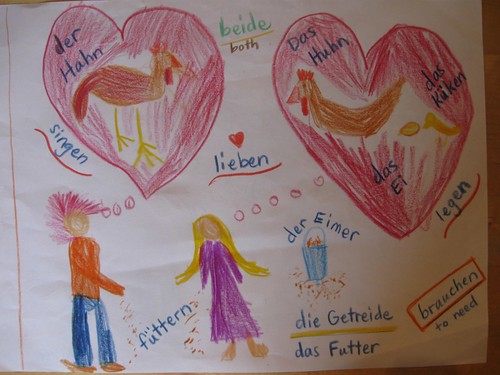
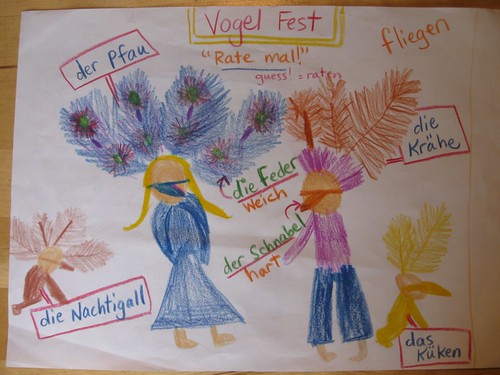
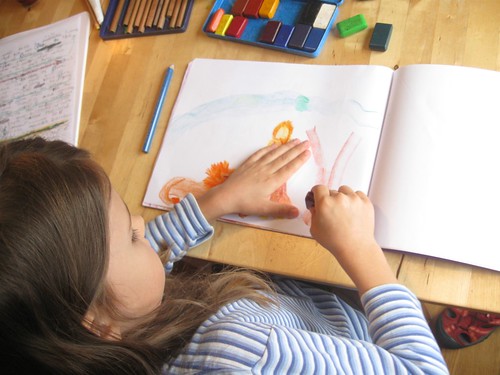
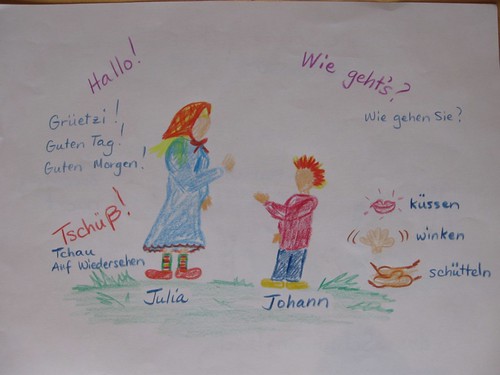
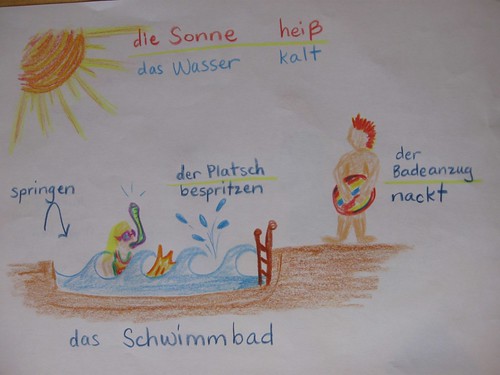
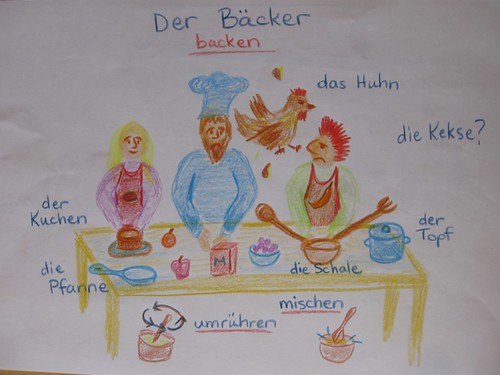
So I tell the story, acting out bits and drawing pictures and words on the chalkboard as I go (usually with a dictionary in my lap), and then the girls and I draw the picture together on paper, purposefully making it as ridiculous as possible. We discuss which words to write-- we only pick a few (less really is more), and I make sure to include verbs. I label my paper, Sunburst copies the words from my paper, and then I help Moonshine label hers.

We've been doing two stories per week, on Monday and Wednesday, and then on Friday the girls are required to put on a very short play for me from the week's lessons. They love this. Plus it gives them a reason to review the work and practice using the language in context and without judgment. Nothing kills the joy of learning a language like judgment. So we don't do that. We just try, together. We keep it fun and silly, and we make complete fools of ourselves. Learning a language requires that above all else-- the courage to look/sound stupid.

Here are some of our pages. Like I said, my stories are pretty ridiculous. I'm sharing all three versions (mine, Sunburst's, and Moonshine's) because I can't choose between them. Anyway, when we feel like we have enough pages we'll bind them together in a book, along with some other (not so exciting) pages we made last year.

Basic greetings, including Swiss and the triple Swiss kiss:


At the Swimming Pool:


A (very strange) Race-- this tied in nicely with a our week of lions:


Cooking with the Baker:


Feeding Chickens:


Bird Party (tied in with bird fables):


These lessons are the heart and soul of our language learning. And they're working. We're really starting to speak and understand German!

We're also doing some fun book work with the language to work on our reading skills-- but I'll have to share that tomorrow.

Saturday, August 21, 2010

Week of lions... and Greece!


Last week, to meet Moonshine's request of more "boy saints," I presented her with a story about St. Jerome and the lion. I wrote her a flute song based on this story, and I was so glad that it was such a hit because I had planned a whole week of lions.


I also mentioned last week that Moonshine is trying out some new behavioral territory. Could it be the nine-year-change approaching already? I'm hesitant to label it as such, but I do know that it's making us all crazy, herself included. She's being antagonistic to everyone and she's not sleeping well. It's a dangerous combination... and well, she rather is like a lion.

I carried over the heart theme from last week, and challenged Moonshine with a poem I wrote just for her. She copied it into her copy book, memorized it, and recited it--- all with great joy! And because she's insisting to write things phonetically and without help, I pulled some words from the poem and challenged her to her very first spelling quiz. She was so excited!! She remembered every single word, and she can't wait for her next quiz.

The poem was very simple, but the message is also very clear:

Fill my heart
with gladness.
Fill my heart
with joy.
Fill my heart
with love
For every girl and boy.

Fill my heart
with kindness.
Fill my heart
with care.
Fill my heart
with tender thoughts
For creatures everywhere.


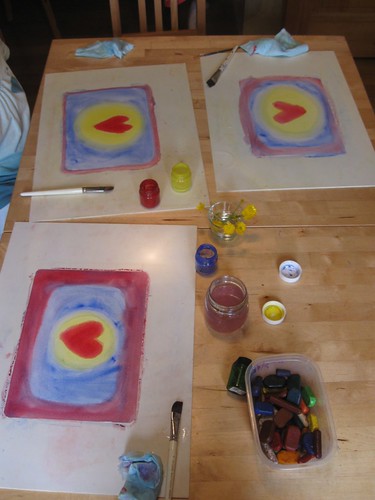
To extend the heart theme, I invited the kids to watercolor-paint some hearts. Then to extend our lion theme, I went ahead and pulled from my second grade materials and told the story of the Lion and the Mouse. It was a good reminder of kindness as well. --Those of you who have Teaching With the Fables by Sieglinde de Francesca will recognize my attempt to recreate the picture from the cover of her lovely, lovely book.


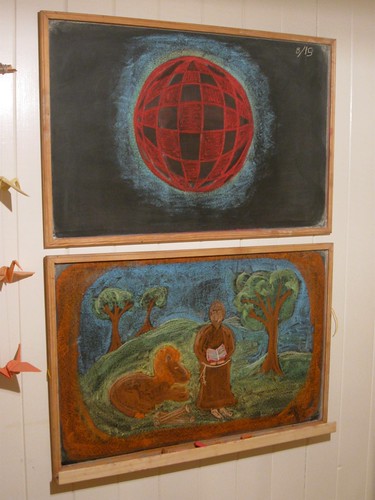
Sunburst and I worked on Greece, Greece, and more Greece. And math, of course. I also tossed another wondrous geometrical form her way, shown at the top of this post. She is lapping it up.

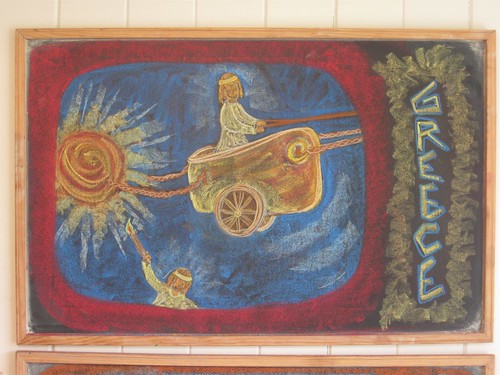
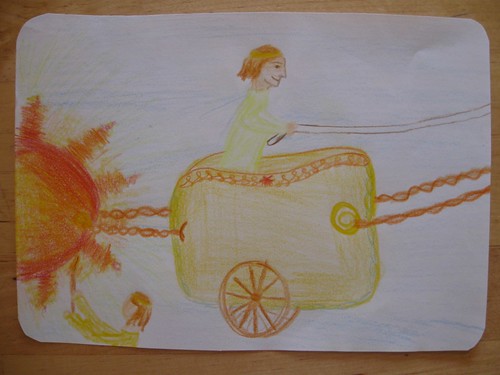
This is our rendition of Helios and the sun chariot with Prometheus stealing fire to give to the humans:


We also worked together to copy out the amazing family tree from the front of D'Aulaire's Book of Greek Myths. It was a challenge, for sure, but we worked at it little by little over the last two weeks, and it's already helping us to keep all the Greek mythological gods and goddesses sorted. Greece is definitely a lot of fun!

Friday, August 20, 2010

Back to lessons

Last week we got back to lessons. I didn't anticipate how busy we would be, nor that the girls were going to have their own ideas about how things should go, so it was a bit hodge-podge. Despite what I had planned, Moonshine desperately wanted to add Saint Catherine of Siena to her saints book. In fact, her only other request was, "Please, can we do more saints!"

I wasn't planning on doing any this year! We had saved the last few pages in her book for memorabilia from our trips (pictures, postcards, bookmarks, pamphlets), but instead, she wanted to do some more "boy saints." Apparently I didn't give the boys fair coverage in our block this past spring. It's a good thing I still had a few more up my sleeve!

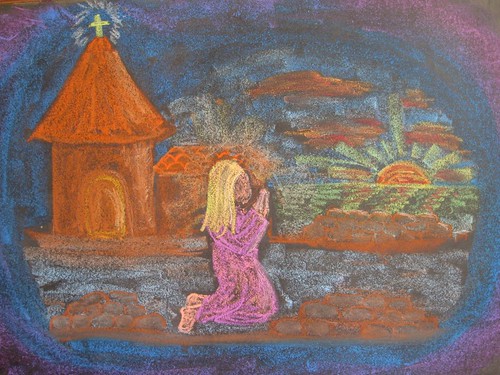
I finally found chalkboard paint this summer, repainted my boards which were in terrible shape, and got them hung back up. It had been so long since I had drawn on the chalkboard, so I was happy to put up my rendition of Saint Catherine gazing at the sunset. Moonshine took one look at it and declared, "Oh, that's just how I imagined it!" ... Whew!


I drew Sunburst a geometric form to wonder about (yes, the heart in the middle is covering up my imperfections... but it's also serving as a reminder to put our hearts into everything we do-- an important reminder, especially given some new behaviors Moonshine is trying out). With chalkboard drawings up and stories to tell, we were off and running.


We also reviewed some math and worked in two German lessons-- I'm trying out a new approach this year, and it seemed to be a big hit. Yay! We also worked in some reading practice, copywork/memorization, and quite a bit of handwork. All that and full afternoons, too!

All in all, it was a good first week.
Related Posts with Thumbnails
 
Site Meter